 Bscscan
 makes BNB Smart Chain records searchable
Bscscan makes BNB Smart Chain transactions searchable and connects them with public address, token and smart contract records. Its explorer shows transaction status, BNB fees and recorded transfers. These linked views help distinguish a network transaction from a token movement and identify the contract involved in a particular interaction.
What does a transaction hash reveal?
A transaction hash identifies one transaction and opens its status, sender, destination, block information and execution details in the explorer. An address groups records associated with an account or contract, while a hash isolates one submission.
Pending indicates that a transaction is awaiting inclusion, while Success indicates successful execution in an included block. Failed indicates unsuccessful execution, although the blockchain still records the included transaction.
Contract input data can encode the requested operation and its arguments. A decoded method helps identify the function that a transaction requested; the contract's code determines what that function does. Input data describes the request, and the execution status reports transaction-level success or failure. A requested action can fail without reverting the transaction.
Failure details distinguish a contract rejection from an execution resource problem. A revert rolls back changes from execution, while an Out of Gas error indicates that execution exhausted its gas allowance. Raising the gas limit does not remove a contract's permission restriction.
Gas charges and block inclusion
Gas measures the execution work that a transaction consumes, while the gas price determines the cost of each unit. The fee equals gas used multiplied by the effective gas price; the gas limit caps permitted work rather than recording final usage. BNB pays the network fee, and Gwei expresses a smaller denomination used for gas prices. One Gwei equals 0.000000001 BNB. A reverted transaction can still consume gas and incur a charge. The Gas Tracker estimates suitable prices from network conditions, so its recommendations can change.
A block groups included transactions and records information such as its timestamp, validator and gas usage. Block height identifies the block's position in the chain. The block's transaction count excludes contract internal transactions, which appear separately in explorer records. Counting those entries as additional independent submissions would overstate the number of submitted transactions.
Address histories and internal transfers
Address pages bring together native BNB balances, token holdings and transaction histories for a public account or deployed contract. The balance describes holdings at the time of the query, while the history records activity across transactions.
An externally owned address is controlled through a private key, while a contract address identifies deployed code whose functions execute through calls. The Contract Creation field helps distinguish contract records.
The Transactions view lists ordinary submitted transactions associated with the address. Internal Txns records calls or native BNB movements that occur during contract execution. BEP-20 transfer histories organize the token events that the explorer recognizes. An address's activity can span several views, even when the entries relate to one originating transaction.
Event logs supply structured records that contracts emit during execution. BEP-20 Transfer events report sending and receiving addresses and token amounts for a particular token contract, while other events describe contract-specific activity. Their meaning follows the emitting contract's code and event definitions, so an unfamiliar log needs that contract's context.
Token identity, holdings and market displays
A token page organizes the token's contract address, supply information, holder distribution and transfer history around one specific asset. The BEP-20 standard defines common functions for fungible-token balances, transfers and spending allowances on BNB Smart Chain. Names and symbols can repeat across contracts, so the contract address supplies the precise identity that a ticker cannot provide.
The holder count measures addresses that hold the token, rather than identified individuals. One person can control several addresses, and an address can hold assets for multiple people. Holder distribution describes those addresses, without directly measuring the number of users or the liquidity available for a trade.
Logos and project descriptions come through a separate information-update process. Supply and transfer records have a different origin from those descriptive additions. Token prices can use supported data from CoinMarketCap or CoinGecko after the token information is updated. Prices and market-value fields do not appear for every token, and their displayed values can change independently of token quantity.
Contract verification and spending permissions
Published contract code exposes rules and callable functions for inspection. Contract verification checks compiled source code against bytecode deployed on the blockchain. A code match does not certify safe behavior. Token approvals for BEP-20 assets give a spender permission to transfer tokens within a specified allowance. The approval checker can review supported allowances and submit revocations, which require a signed transaction.
Transaction fields for a token transfer
For a BEP-20 transfer, the transaction destination can identify the token contract while a transfer entry identifies the recipient. Reading the contract call as a direct BNB payment would confuse those roles.
- Use the status field when deciding whether the network execution succeeded.
- For the token recipient, inspect the destination in the relevant token transfer entry.
- Read the Value field when the question concerns native BNB attached to the call.
- Separate the transaction fee from transferred value when identifying the network processing cost.
- Match the token contract address when deciding which asset a transfer record describes.
A transfer entry reports a movement described by the token contract, without establishing future transferability or certifying the token's economic value.
Can public browsing change a wallet balance?
Viewing public records cannot change a wallet balance; contract write functions require a signed transaction to alter blockchain state. Read functions retrieve contract values without submitting a state-changing transaction. Write functions request actions through a connected wallet, with network gas costs and the contract's own permission rules applying to execution.
Sharing an address gives others access to its visible transactions and token holdings; a public name tag can associate it with an identified entity. Private keys and recovery phrases are unnecessary for public lookups and should never be entered into explorer searches or private notes.
The explorer displays network records and provides contract interfaces. It cannot reverse a completed transfer, redirect the recipient or recover funds through a support request.
Activity trackers, saved views and API access
The DEX Tracker groups recognized decentralized exchange trades and displays the tokens sent and received, trading venue and transaction hash. Coverage follows its supported exchange list, so the tracker does not describe every possible exchange interaction. Non-fungible token (NFT) views separate mints, transfers and marketplace trades. Transfer records identify movement of an item; marketplace trade entries add the venue and price. A transfer alone does not establish that a sale occurred, and the trade tracker's coverage follows its supported marketplace list.
A registered explorer account adds private notes, address tags and watch-list notifications. These features organize records and provide alerts for selected addresses. They do not change recorded balances or give control of an address. Token analytics and event filtering provide other ways to examine patterns within the indexed activity.
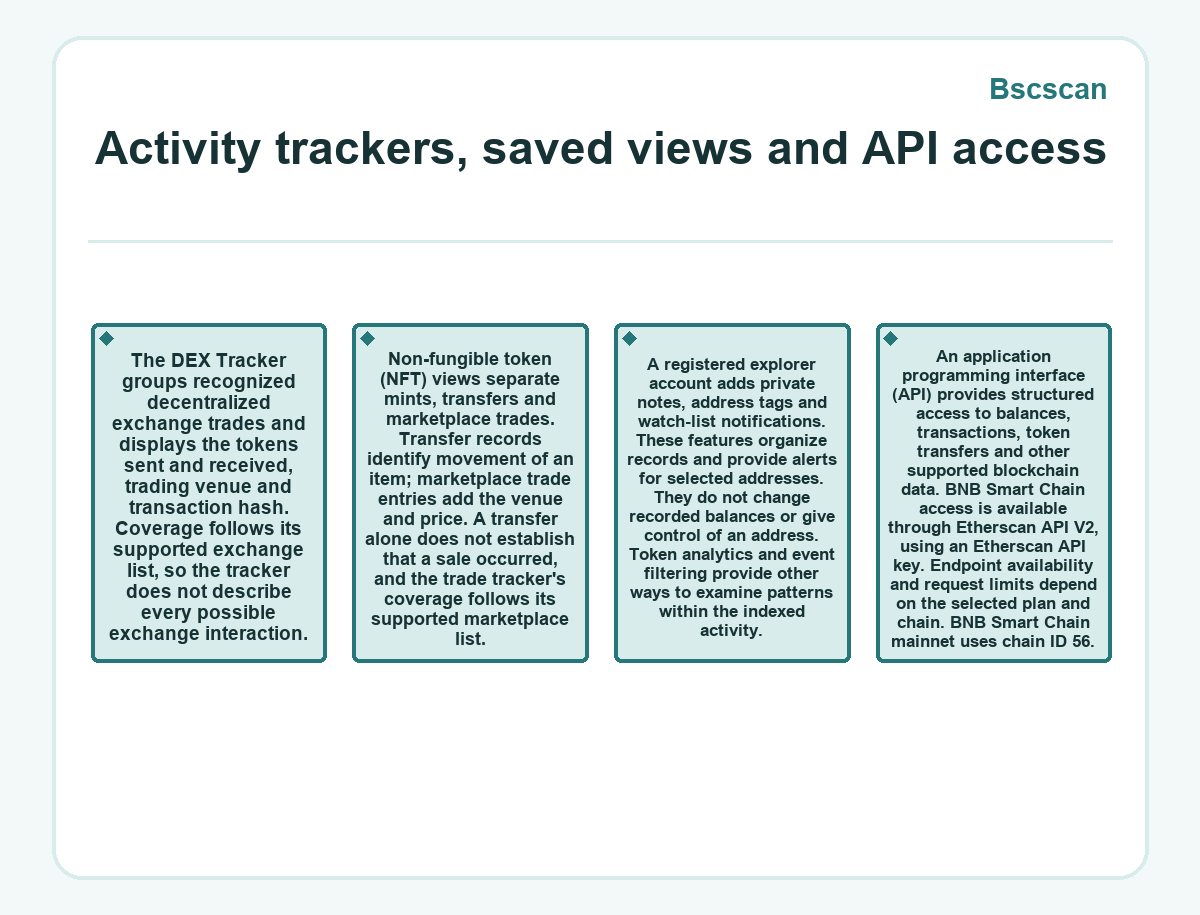
An application programming interface (API) provides structured access to balances, transactions, token transfers and other supported blockchain data. BNB Smart Chain access is available through Etherscan API V2, using an Etherscan API key. Endpoint availability and request limits depend on the selected plan and chain. BNB Smart Chain mainnet uses chain ID 56.
Reader questions
-
Do I need an account to search public transactions?
- You do not need an explorer account to search public transactions or address records. Account registration applies to personal features such as saved notes and watch-list alerts. Viewing a public record also does not require access to the wallet that controls the address, because the displayed activity belongs to the public ledger.
-
How long does a successful transaction take to appear in an exchange account?
- The receiving exchange controls when a successful blockchain transaction appears in its account balance. Its confirmation requirements and deposit-processing rules can add waiting time after network execution. A Success status establishes the transaction's execution state; it does not establish that the exchange has finished crediting its internal customer balance.
-
Does an UNKNOWN reputation label identify a token as a scam?
- An UNKNOWN label means the explorer has not assigned a more specific reputation assessment to that token. It does not by itself establish fraud. The default label can remain even after a creator supplies a logo and basic project information, so descriptive metadata and reputation assessment should not be treated as the same finding.
-
What happens if I add a token to the Private Token Ignore List?
- The Private Token Ignore List hides selected tokens from relevant holdings displays while you are logged into your explorer account. It can also exclude their displayed values from holdings totals. This changes your viewing preferences; it does not delete transfer events, remove the tokens from the address or change the token contract.
-
Is BNB Smart Chain testnet activity included in mainnet search results?
- BNB Smart Chain testnet activity belongs to a separate ledger and appears in the testnet explorer environment. Mainnet searches cover mainnet records, even when the same address format is used on both networks. API queries also select an environment explicitly: mainnet uses chain ID 56, while testnet uses chain ID 97.