 Bscscan
 contract verification links published source code to deployed contract bytecode
Bscscan contract verification checks whether submitted source code compiles to the contract bytecode recorded on BNB Smart Chain. Exact Match includes deployment-specific constructor arguments; Similar Match associates code with an already verified contract without confirming those arguments. Identical logic can begin with different administrative settings, so a shared source listing does not establish identical control. A proxy's match covers its own code; its forwarding logic and implementation also affect the behavior at that address.
The short version: Similar Match leaves constructor inputs unconfirmed, so identical published logic can belong to deployments with different initial administrators.
Source, bytecode and callable functions
Source code explains the contract's logic, bytecode contains executable instructions and the application binary interface (ABI) describes its callable functions. Verification connects the readable program with compiled code at the selected address and network. Function and parameter types support the explorer's interaction forms. The verified source makes approval and privileged functions inspectable, although interface details alone do not establish who may execute them. If a contract exists at the same address on another network, it is a separate deployment.
Exact Match and Similar Match
An Exact Match result covers the deployed contract code together with the constructor arguments used for that particular instance. Its deployment details support an address-specific comparison of initial inputs. The label does not establish whether ordinary stored values later changed through permitted functions. Similar Match automatically associates a contract with an existing verified contract whose creation bytecode matches. Similar Match does not account for constructor arguments. The displayed matched address identifies the code association.
An Unverified listing exposes bytecode without a verified source association, leaving higher-level analysis dependent on obtaining the relevant source or examining bytecode.
Constructor arguments and stored settings
Constructor arguments establish deployment inputs, while ordinary state variables can change later through functions that the contract actually permits. The arguments use ABI encoding, so their types and order must agree with the constructor definition. Decoded values explain the initial configuration only in conjunction with the constructor logic that processes them. An input can be transformed before storage or used to initialize another contract.
For a simple public state variable, a compiler-generated getter reports its present value when queried. Solidity does not automatically generate a setter alongside that getter. Whether a value can change follows from the contract's functions, inherited code and relevant access conditions. Public visibility alone therefore establishes neither unrestricted modification nor immutability.
An immutable value becomes fixed after construction. That property applies to the declared value; it does not freeze unrelated settings or external contract behavior.
Reproducing the deployment build
Build reproduction depends on the original compilation inputs, including the compiler release and the settings that influenced the generated bytecode. A source listing with familiar function names can still produce a different binary when those inputs change.
Compiler release and EVM target
The exact compiler release matters when reproducing an existing deployment. The Ethereum Virtual Machine (EVM) target also affects available instructions and compilation behavior. Selecting a newer release or a different target changes the build being compared. Verification concerns the deployed artifact, even when a later compiler accepts the same source.
Optimizer and compilation pipeline
Optimizer configuration includes whether optimization was enabled and the chosen runs setting. The runs value guides optimization for expected execution frequency; it does not count optimizer passes. The
viaIR
setting selects compilation through an intermediate representation and must reflect the deployment build.
Imported files and linked libraries
Imported dependency versions and source contents belong to the build alongside the main contract file. Externally linked libraries also require the addresses linked into the deployed bytecode. A library name identifies a dependency, while its linked address identifies the deployed code that the contract calls.
Source formats and metadata
Standard JSON Input carries source units and compiler settings together, preserving options that a simple verification form may not expose. Bscscan supports this method for advanced settings such as
viaIR
and
bytecodeHash
. Single-file verification supplies the complete source in one file. That route requires imports to be incorporated appropriately; the dependency versions must match the deployment build.
Compiler metadata records compilation settings and source information. Solidity normally appends a metadata hash to runtime bytecode, although settings can alter that behavior. When the hash is present, changing a filename, source path or whitespace can change the metadata and compiled bytes. A behaviorally equivalent edit may therefore fail to reproduce the original build. Metadata settings belong to the comparison whenever they affect its output.
The match classification should not be treated as proof of a repository's release history or the identity of its author.
Proxy source and implementation changes
A proxy separates the address receiving calls from implementation code that it invokes, so a meaningful examination follows the actual forwarding behavior. Source verification of the proxy and identification of its implementation answer different questions.
Verified forwarding code
A match for proxy bytecode establishes the source association of that forwarding contract. It does not extend the same verification result to an implementation address. The implementation needs its own code examination, and the proxy determines which calls reach it.
Detected implementation and ABI
Read as Proxy and Write as Proxy use the detected implementation's ABI. Detection relies on heuristics, and contracts using libraries can also contain
delegatecall
. Those tabs do not certify that the displayed implementation actually handles every interaction.
Changes after an upgrade
An upgradeable proxy can change its implementation when its upgrade rules permit. The proxy's source match does not freeze that destination. Refreshing proxy detection can update the displayed implementation association; the forwarding code and actual destination still determine the applicable logic.
Bytecode mismatch and failed submissions
A bytecode mismatch means that the supplied build did not reproduce the artifact that the verifier expected at the selected address.
The cause can be an incorrect compiler release, optimizer setting, dependency, library address or constructor payload. Compilation warnings and verification diagnostics help localize the discrepancy. A mismatch alone does not establish malicious code.
The corrective task is to recover the deployment's inputs and reproduce the original artifact. A missing dependency is a compilation problem; an incorrect constructor argument affects deployment matching. Metadata differences need their own comparison because the executable logic can remain unchanged. An inability to locate contract code is a different state from a mismatch. The target address, chain selection and successful deployment establish whether code should be present. Explorer visibility can lag deployment, so a missing listing alone does not establish that no contract exists.
A different deployment administrator
Changing a stored administrator can preserve the same contract logic while changing who satisfies an administrative access check. In this hypothetical example, two deployments use identical Solidity source and compiler settings. Their constructor arguments select different administrator addresses, which the constructor stores in ordinary state variables. The source exposes a public getter and a setter that requires the caller to equal the stored administrator.
The first deployment has an Exact Match label. The second has a Similar Match label pointing to the first. Reading the associated source establishes how the administrator check works in the shared logic. It does not establish that the second deployment began with the first deployment's administrator.
The differing constructor argument changes the initial holder of administrative authority without requiring different runtime instructions.
If the authorized setter subsequently changes the administrator, the original argument describes an earlier state. Reading the current getter establishes the address presently stored. Neither that query nor the borrowed source changes Similar Match into confirmation of the original constructor payload.
The second deployment's getter therefore identifies the address that passes the setter's administrator comparison now. Its initial administrator remains unconfirmed if the original creation input is unavailable.
Does an Exact Match label prove that a contract is safe?
An Exact Match label establishes a deployment-related code match, while safety also depends on what the code permits under relevant conditions. Source verification enables inspection of those conditions. A security assessment investigates exploitable behavior and assumptions, while formal verification evaluates specified properties. Neither assessment follows automatically from publication or a match label.
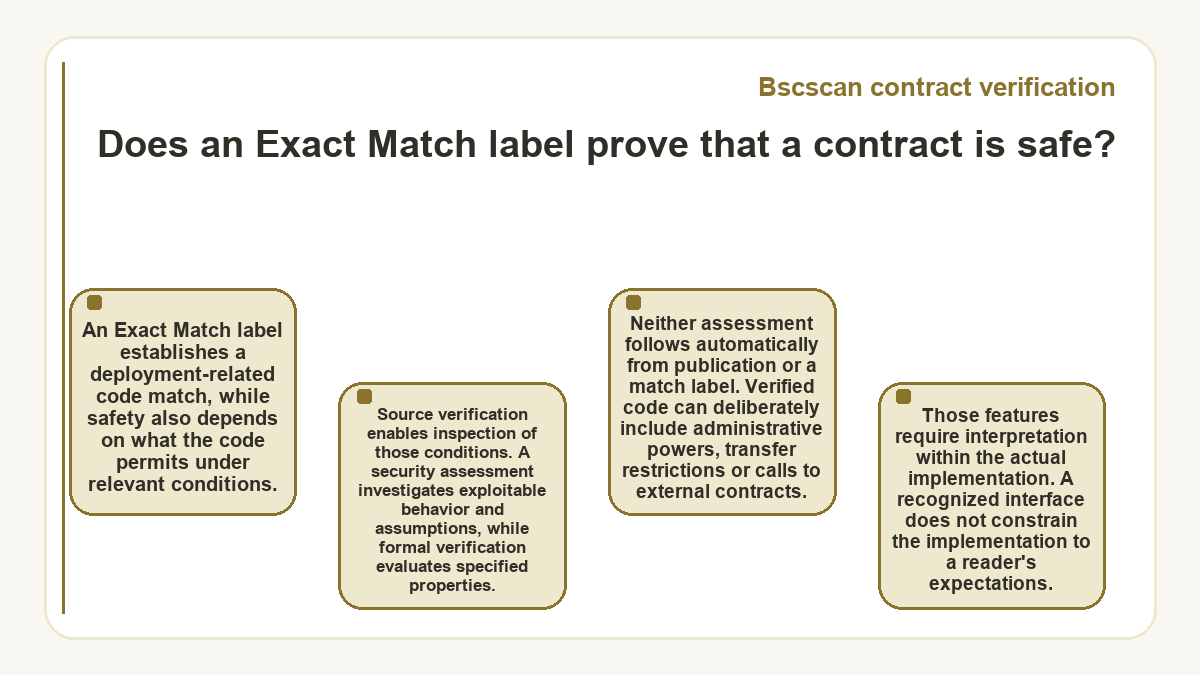
Verified code can deliberately include administrative powers, transfer restrictions or calls to external contracts. Those features require interpretation within the actual implementation. A recognized interface does not constrain the implementation to a reader's expectations.
Creation code and deployed code
Creation bytecode includes logic that runs during deployment, while runtime bytecode contains the program left at the address afterward. Solidity executes the constructor once during creation; constructor-only logic is absent from the final deployed code. ABI-encoded constructor arguments accompany creation code, rather than appearing as ordinary runtime function arguments. Comparing a deployment payload directly with runtime code therefore compares different artifacts. Constructor-set immutable values can also affect the final runtime bytes.
Enforced restrictions and administrative permissions
A claimed restriction has practical force when the relevant execution paths enforce it and the current settings satisfy its stated conditions. Descriptive comments and variable names do not impose checks. A timestamp named as an unlock time establishes no lock by itself. The transfer logic must use that value in a condition that affects whether execution proceeds.
Inherited functions, alternative entry points and authorized setters can change the scope of a restriction. Token transfer logs describe recorded execution events; they do not establish that every future transfer faces the same condition. Once the code association is understood, the next decision is whether the intended action follows a path that actually enforces the claimed limit. That examination belongs to the specific deployed contract and its applicable state.
Bscscan contract verification: quick answers
Do I need to prove contract ownership before inspecting verified source code?
Contract address ownership verification is separate from reading publicly available verified source code. The ownership procedure associates a contract with an explorer account for administrative submissions, including token-information updates. That association does not replace source verification or change the access rules that the deployed contract enforces.
Why does a Solidity pragma not identify the exact deployment compiler?
A Solidity version pragma can permit a range of compiler releases, so it need not identify the release used for deployment. It checks compiler compatibility without selecting or changing the compiler itself. Reproducing a deployment therefore requires the actual build's compiler version, even when several releases accept the source.
Can a factory-created contract have its own verified source code?
A contract created by a factory has its own deployed bytecode and can have its own source verification. Verifying the factory does not establish a source match for every contract it creates. The child contract's compilation and creation inputs matter, even when its creation occurs inside another contract's execution.
Is a verification submission identifier proof that publication finished?
A verification submission identifier tracks a request; it does not confirm a completed source match. The verification API supplies that identifier so a status query can retrieve the outcome. A completed response such as Pass - Verified establishes success for that request, whereas acceptance of the submission alone does not establish completion.
What happens to verification when a constructor has no parameters?
A constructor with no parameters requires no constructor-argument values for verification. The source and compilation settings still need to reproduce the deployed artifact. A parameterless constructor can perform initialization through its code, so an empty argument payload does not imply that deployment performed no initialization.
Are private Solidity variables hidden after source verification?
Solidity private visibility restricts access from other contracts and derived code; it does not make blockchain data confidential. Publishing verified source can make the storage logic easier to understand, while the underlying data was already publicly observable. Private visibility should not be interpreted as encryption or a promise of secrecy.
Which contract name should a source submission containing several contracts identify?
The submission must identify the specific compiled contract that exists at the target address. With Standard JSON Input, the contract-name field identifies the source path and contract name separated by a colon. Selecting another contract from the same source collection targets a different compilation output, even when the file includes both definitions.